
A hundred calls with short-term rental businesses: what we've learned
The five topics that come up most often, what holds people back before getting equipped, and what can be done in practice.
A hundred calls with property managers: what we've learned
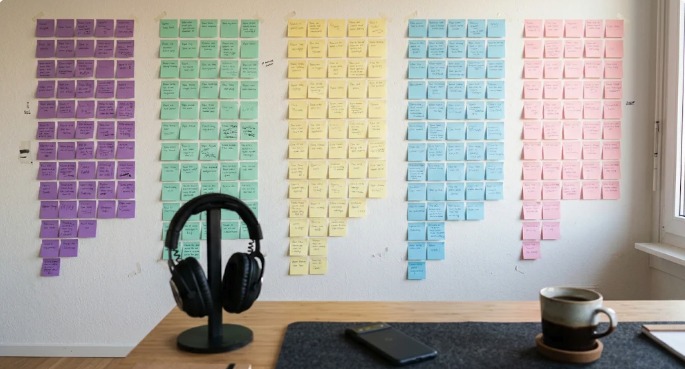
For nearly a year, we talked with short-term rental (STR) companies of all sizes: from startups with a few properties to organisations managing hundreds. In the mountains, in the city, on the coast. A hundred calls, reviewed one by one, and more than 600 phrases selected and analysed. Here are the five topics that come up most often, what holds people back from getting equipped, and what can be done in practice.
By Laurent Dumoulin · Reading time: 9 minutes
How we worked
These calls were of different natures: initial discussions, demonstrations, setups, and regular check-ins with clients. STR businesses in the mountains, on the coast, in the city, in France, and in Switzerland. Some are just starting out, others manage over a hundred properties with multiple teams.
In each call, we noted phrases that said something about the profession: a problem, a reaction, a way of seeing the market. Then we categorised them by theme. Two lists emerged, and they don't look alike. The first says what weighs on daily life. The second says what holds people back when it's time to equip themselves with a tool.
The quotes here are anonymised and cleaned of speech fillers. The figures are orders of magnitude.
1. Mental load: always on standby
This is the subject that outweighs all others. It comes up in three out of four calls, regardless of the size of the company.
What's striking is that working hours rarely come first. What weighs heavy is being always available, on the lookout for the next request. The guest's question, the cleaning team's photo, the owner's approval: everything arrives on the same phone or the same platform, at any hour. Here is what we heard:
"These are our personal numbers, so we never disconnect. Someone sends us a message at 2 a.m., I inevitably see it, since it's my phone."
"It's not necessarily the time, it's more the energy it takes, because we jump from one subject to another."
In hindsight, this isn't surprising. At the beginning, everything goes through the manager because there is only them. Then properties arrive, the team too, and the workflow stays the same. Three things help, and none require a tool:
Separate the number from the person. A number in the name of the company, on a line that someone else can take over in the evening or on weekends.
Put the answers where they are looked for. The wifi code, cleaning time, the plumber's number, written once: in the welcome booklet for the guest, in the property sheet for the team.
Delegate by request type. One category first, then a second, with a process that says who is responsible for it.
Takeaway. You never completely exit the loop, and that's not necessarily desirable. But between "everything" and "the essentials," there is plenty of room to move.
2. AI: trust built in stages
The subject is polarising, with very different approaches from one manager to another. One manager, regarding the responses AI prepared for his guests, summarised:
"100% of the time, I delete them."
Another client activated autopilot day and night in just a few days. The difference lies mainly in the data. For the second one, there were already several months of bookings and conversations, and complete property sheets: the AI knew how he spoke to his guests. For the first, it was starting from scratch, and the tone still needed adjusting.
Between the two, almost everyone follows the same path. We start by reviewing each response. Then we let the AI respond at night:
"We will certainly activate automatic AI at night. When I'm sleeping, let the AI take over."
Then we entrust it with questions where the answer doesn't change: wifi, check-in time, parking. And we keep for ourselves what builds the relationship:
"It lets me answer the nice questions, chat with the guest. All the practical answers, the AI handles those."
Three ways of moving forward coexist: the co-pilot, where the AI prepares and the manager validates; the staged autopilot, first at night, then for simple questions; and immediate autopilot, when the history and property information are already there. The common point is that everyone wants to move towards autopilot, especially in high season.
Takeaway. Trust in AI follows the quality of the information you give it. Property sheets and written rules matter more than fine-tuning the tone.
3. Owners: a permanent transfer window
The third subject is the one rarely discussed in public, but often among managers. Owners compare, change companies, sometimes come back. For some, it's even a first experience. The movement itself is permanent. Here is what we heard:
"This is the first year I'm losing owners."
"I lost maybe 5 or 10 clients this year. I gained 15, but you see the amount of work that creates."
Every arrival requires a setup, every departure leaves a hole in the teams' schedule. And it's not always bad news: some departures allow for refocusing the portfolio on properties where real quality work can be done.
What owners ask for often comes down to the same things: knowing how much they really earn once commissions are deducted, seeing the calendar, and understanding what is happening in their property. Someone explained to us that their owners "only saw processes anymore." Managing a property is no longer enough. The job is moving toward that of a partner, helping the owner add value to their real estate assets.
Takeaway. You have to distinguish between what you endure and what you choose. Transparency on income and the work done on-site is what retains clients best.
4. Growth milestones: ten, then forty
There are moments when the organisation that worked until then no longer holds up. The numbers vary according to properties and teams, but we mostly hear two.
The first happens around ten properties. Until then, you know every guest, you answer from memory, you send access codes from your phone. Then the volume overtakes memory.
"It's super basic: I do copy-paste all day, I just change the date and the name of the villa."
The second happens around forty. There are several cleaning teams, a technician, sometimes someone at the front desk, and the manager can no longer be the only one who knows who is doing what.
"There was a sort of threshold, up to about forty properties. Beyond that, it really forced me to change dimensions."
Before the first milestone, what helps is documenting: answers to recurring questions, access, house rules, who receives what. This is what allows for automating the basics, quickly and simply. Before the second, it's about processes: who does what and when, how we check it's done, and how information flows between teams, the manager, and the owners. Without this, every new team adds messages instead of adding capacity.
In our own STR company in Switzerland, the first milestone arrived around eight or ten properties. We were copy-pasting message templates all day, and that's when we decided to write everything down, then automate.
5. WhatsApp for guests: a matter of agreement
It's often the last question before getting equipped: will my guests accept WhatsApp? Some managers have had the experience:
"They don't use WhatsApp at all. I asked them four times."
It happens, and you have to plan for it. But it's the exception. The argument we hear most often concerns guests from countries where WhatsApp is reportedly used less. In our Swiss company, we welcomed many: when they travel, almost all of them have it.
What has changed are the platforms, which share guest contact details less and less. The right approach is therefore not to ask for a number, but to suggest the guest exchange on WhatsApp a few days before arrival, telling them why: access, arrival time, a question during the stay. For our clients, since implementing an arrival form in the welcome booklet, over 95% of guests provide their number.
For the others, email remains a good last resort. And regardless of the channel, what prevents the most questions is a good welcome booklet that answers before one needs to ask.
What holds people back before getting equipped
The second list doesn't look like the first. What weighs most on the day is that everything goes through the manager. What triggers, or blocks, the search for a solution is another question: will this be an addition to what I already have?
"What I'm really asked for is that something be set up quickly, and be as simple as possible to use."
Managers don't want one more tool. They want simplicity. Next comes adoption by teams, who are already working in WhatsApp and don't want to leave it, and setup time, which is much shorter when rules are already written.
"Teams don't want to connect to interfaces. They want to have all the information on WhatsApp."
Takeaway. You have to answer the simplicity question to earn the right to talk about mental load.
Where to start
Put together, these five topics provide a starting point that requires no tools.
Write down the three basic rules: who receives what, who answers and who is informed, what we promise the guest. One page is enough.
Switch to a number in the company's name, which someone else can handle in the evening and on weekends.
Complete the property sheets and the welcome booklet. This is what allows you to delegate, to a person or to an AI.
Choose a first category of requests to hand over, either night-time or practical questions, and see how it goes for a month.
Show owners what is done for them: net income, the calendar, on-site interventions.
These topics aren't reserved for large structures. We hear them at five properties just as at two hundred, at different stages.
And in smartiz? Guest messages, team tasks, and owner reports go through WhatsApp, where everyone already works. The AI starts as a co-pilot and moves to autopilot property by property, at each person's own pace. For our clients, 95% of messages and tasks are handled without human intervention, for less than 10 minutes of work per stay.